
Publications
-
Calibration uncertainties are the leading systematics in cosmological analyses using Type Ia supernovae (SNe Ia). For the Nancy Grace Roman Space Telescope (Roman), we quantify the impact of chromatic effects on SNe Ia photometry and derived cosmological parameters, using simulated light curves from the High-Latitude Time Domain Survey. We investigate two sources of wavelength-dependent bias: focal plane array (FPA)-dependent wavelength shifts arising from spatial variations across Roman's 18 detectors, and coherent wavelength shifts corresponding to the measured 0.06% uncertainty in absolute filter wavelength calibration. Using simulated SNe Ia light curves, we find that the FPA-dependent shifts -- which range from +6 to -80 Å introduce a redshift-dependent distance modulus bias that, if left uncorrected, propagates to Δw0∼−0.06 and Δwa=−0.236, which are larger than the forecast statistical uncertainties of σstat,w0=0.025 and σstat,wa=0.114, rendering the survey systematics-limited. We probe the impact of chromatic effects by employing detector-specific filter curves that recover unbiased cosmological constraints; to remain below the statistical noise floor, FPA wavelength shifts must be characterized to within 20%. In contrast, a coherent 0.06% offset in filter wavelength calibration -- ranging from -3 to -11 Å -- produces negligible redshift-dependent bias, with a minimal spread in wa (Δwa=−0.0004,σwa,sys=0.114), demonstrating that the achieved pre-launch calibration precision is sufficient for this systematic to remain subdominant. Our results establish that chromatic effects are a required component of SN Ia cosmology with Roman.
Submitted. 2026arXiv260708886P
-
In the coming years, the Vera Rubin Observatory's Legacy Survey of Space and Time (Rubin-LSST) and the Nancy Grace Roman Space Telescope's (Roman) High Latitude Time Domain Survey (HLTDS) are expected to discover more than a million Type Ia supernovae (SNe Ia), several orders of magnitude more than current samples and with a tighter control on systematic uncertainties. One of the largest systematic uncertainties in cosmological analyses with SNe Ia is the accuracy of the spectro-photometric model for SNe Ia time series data, which depends on the photometric calibration of the surveys. To quantify the impact of this uncertainty, we analyze simulated Rubin-LSST and HLTDS data, perturb the photometric zero-points and filter mean wavelengths, and propagate these systematics to spectral model recovery, estimated distances, and dark energy figure of merit (FoM) based on the w0waCDM model. Zero-point shifts of 5 mmag and filter mean wavelength shifts of 5 angstrom lead to a ∼50% decrease in the FoM relative to a statistical-only case when calibration uncertainties are propagated only through light-curve fitting. The same calibration shifts applied only during model training produce a smaller ∼13% degradation. Contrary to previous analyses, calibration uncertainties in light-curve fitting dominate over those from model training. Their effect during light-curve fitting varies smoothly with redshift and is nearly degenerate with cosmology, preventing mitigation through self-calibration. Finally, we show that the FoM dependence on the size of the calibration uncertainties (in the range of expected sizes) is roughly linear.
Accepted. 2026arXiv260419746A
-
Slitless spectroscopy enables efficient, large-area surveys without target preselection, yet it faces challenges from source blending, higher noise, and lost spatial─spectral information. We present an advanced, nonparametric, data-driven algorithm that leverages multiple dispersion angles to reconstruct three-dimensional flux distributions, providing low-resolution integral field unit capabilities from slitless data. By treating each pixel as an independent element, our method naturally handles source confusion without requiring prior assumptions regarding redshifts, templates, or model libraries. We validate the algorithm using simulated Roman Space Telescope wide-field slitless spectroscopy images that are equivalent to what is expected from the High-Latitude Time-Domain Survey. First, we demonstrate that a host-galaxy model reconstructed from multiple dispersion angles can be used to accurately subtract host light from a transient, recovering a Type Ia supernova spectrum with minimal bias. Second, we showcase a high-fidelity flux-cube reconstruction of a complex galaxy, successfully measuring the redshift and recovering continuum, emission, and absorption features. This approach highlights the potential of multi-dispersion-angle slitless data to provide spatially resolved spectral information in a nonparametric way, which is traditionally accessible only with integral field spectroscopy, opening a new window into large, unbiased, and spatially resolved studies of galaxy evolution.
Published in ApJ. DOI: 10.3847/1538-3881/ae7a48.
-
The Nancy Grace Roman Space Telescope will carry out a wide-field imaging and slitless spectroscopic survey of Type Ia supernovae to improve our understanding of dark energy. Crucial to this endeavor is obtaining supernova spectra uncontaminated by light from their host galaxies. However, obtaining such spectra is made more difficult by the inherent problem in wide-field slitless spectroscopic surveys: the blending of spectra of close objects. The spectrum of a supernova will blend with the host galaxy, even from regions distant from the supernova on the sky. If not properly removed, this contamination will introduce systematic bias when the supernova spectra are later used to determine intrinsic supernova parameters and to infer the parameters of dark energy. To address this problem, we developed an algorithm that makes use of the spectroscopic observations of the host galaxy at all available observatory roll angles to reconstruct a 3D (2D spatial, 1D spectral) representation of the underlying host galaxy that accurately matches the 2D slitless spectrum of the host galaxy when projected to an arbitrary rotation angle. We call this "scene reconstruction." The projection of the reconstructed scene can be subtracted from an observation of a supernova to remove the contamination from the underlying host. Using simulated Roman data, we show that our method has extremely small systematic errors and significantly less random noise than if we subtracted a single perfectly aligned spectrum of the host obtained before or after the supernova was visible.
Published in ApJ. DOI: 10.3847/1538-4357/ae355e
-
The High-Latitude Time-Domain Survey (HLTDS) for the Nancy Grace Roman Space Telescope (Roman) will discover thousands of high redshift Type Ia supernovae (SNe Ia) to make generation-defining precision cosmological constraints on dark energy. To construct the Roman SN Hubble diagram, a strategy to obtain redshifts must be determined. While the nominal HLTDS will use only the Roman P127 prism spectral element, in this work we consider the utility of the Roman G150 grism for SNe Ia cosmology. We determine a general galaxy grism redshift recovery rate by simulating dispersed grism images and measuring redshifts with the Grizli software. We define a successfully measured redshift as having $\sigma_z = (|z - z_{\rm true}|)/(1+z)\leq 0.02$, signal-to-noise ratio $\geq 5$, and a single dominant peak in the $p(z)$, or a 6.5$\sigma$ detection of two or more emission lines, measuring a 50\% redshift recovery rate at magnitude \fifty\ and 90\% recovery at magnitude \ninety. To provide an approximate picture of the total number of spectroscopic redshifts that will be available for Roman SN cosmology, we also consider a Roman prism redshift efficiency for redshifts measured from SN spectra and a current ground-based telescope redshift efficiency for host-galaxies as a proxy for the Subaru Telescope Prime Focus Spectrograph. We apply these redshift efficiencies to SNIa catalog level simulations and predict that $\sim$6500 SNe will have a spectroscopic redshift from either the SN spectrum or host-galaxy. Second, we evaluate the size of potential systematics related to the modeling of the redshift efficiency, as either a function of host galaxy magnitude, magnitude and stellar mass, or magnitude and host galaxy color. We estimate the largest potential size of this systematic to be \womasssyst{} and \wamasssyst{} on $w_0$ and $w_a$ respectively. Lastly, we consider the effects of assuming different redshift sources on the HLTDS survey strategy optimization by measuring relative changes to the dark energy Figure of Merit (FoM).
Published in ApJ. DOI: 10.3847/1538-4357/ae42be
-
NASA’s Nancy Grace Roman Space Telescope (Roman) will provide an opportunity to study dark energy with unprecedented precision using several techniques, including measurements of Type Ia Supernovae (SNe Ia). The Roman High Latitude Time Domain Survey (HLTDS) will observe SNe Ia out to a higher redshift than ever before (z <= 3.0). We characterize this precision in terms of spatial, magnitude, and color dependences using repeatability of stellar fluxes when sky noise is subdominant, which must be below 1% to enable a number of calibration requirements. Achieving this level of flux precision requires attention to Roman's highly-structured, spatially-varying, undersampled PSF. In this work, we build a library of effective PSFs (ePSFs) compatible with the OpenUniverse HLTDS simulations. Using our library of ePSFs, we recover fractional flux between 0.6 - 1.2% photometric precision, finding that redder bands perform better by this metric. We also find that flux recovery is improved by up to 20% when a chip (sensor chip assembly; SCA) is divided into 8 sub-SCAs in order to account for the spatial variation of the PSF. We measure nonlinearity (magnitude dependence) at |s_{NL}| < 1.93 \times 10^{-3} per dex. Color dependence is inconclusive based on this analysis. Finally, we characterize the detection efficiency function of each OpenUniverse Roman filter, which will inform future studies.
Published in AJ. DOI: 10.3847/1538-3881/ae3714
OpenUniverse2024: A shared, simulated view of the sky for the next generation of cosmological surveys
OpenUniverse, The LSST Dark Energy Science Collaboration, The Roman HLIS Project Infrastructure Team, & The Roman RAPID Project Infrastructure Team
The OpenUniverse2024 simulation suite is a cross-collaboration effort to produce matched simulated imaging for multiple surveys as they would observe a common simulated sky. Both the simulated data and associated tools used to produce it are intended to uniquely enable a wide range of studies to maximize the science potential of the next generation of cosmological surveys. We have produced simulated imaging for approximately 70 deg2 of the Vera C. Rubin Observatory Legacy Survey of Space and Time (LSST) Wide-Fast-Deep survey and the Nancy Grace Roman Space Telescope High-Latitude Wide-Area Survey, as well as overlapping versions of the ELAIS-S1 Deep-Drilling Field for LSST and the High-Latitude Time-Domain Survey for Roman. OpenUniverse2024 includes i) an early version of the updated extragalactic model called Diffsky, which substantially improves the realism of optical and infrared photometry of objects, compared to previous versions of these models; ii) updated transient models that extend through the wavelength range probed by Roman and Rubin; and iii) improved survey, telescope, and instrument realism based on up-to-date survey plans and known properties of the instruments. It is built on a new and updated suite of simulation tools that improves the ease of consistently simulating multiple observatories viewing the same sky. The approximately 400 TB of synthetic survey imaging and simulated universe catalogs are publicly available, and we preview some scientific uses of the simulations.
This research is published in MNRAS: 2025MNRAS.544.3799O

Cosmology Constraints from Type Ia Supernova Simulations of the Nancy Grace Roman Space Telescope Strategy Recommended by the High Latitude Time Domain Survey Definition Committee
Lead Authors: Richard Kessler, Rebekah Hounsell; Bhavin Joshi; Robert Knop; David Rubin
Within the next few years, the upcoming Nancy Grace Roman Space Telescope will be gathering data for the High Latitude Time Domain Survey (HLTDS) that will be used for the most precise Type Ia supernova measurement of the dark energy equation of state parameters w0 and wa. Here we generate a catalog-level simulation of the in-guide strategy recommended by the HLTDS definition committee, and determine dark energy parameter constraints using a detailed analysis that includes light curve fitting, photometric redshifts and classification, BEAMS formalism, systematic uncertainties, and cosmology fitting. After analysis and selection requirements, the sample includes nearly 11,000 roman SNe Ia that we combine with ∼4,500 events from LSST. The analysis demonstrates that current methods work well on Roman data, and the resulting dark energy figure of merit is well above the NASA mission requirement of 326, with the caveat that SN Ia model training systematics have not been included
This research published in ApJ: 2025ApJ...993..116K

phrosty: A Difference Imaging Pipeline for Roman
Lead Authors: Lauren Aldoroty, Lei Hu; R. Knop; D. Scolnic; S. Liu; W. M. Wood-Vasey; M. Troxel; M. Manos; L. Erlandson
NASA’s Nancy Grace Roman Space Telescope (Roman) will provide an opportunity to study dark energy with unprecedented precision using several techniques, including measurements of Type Ia Supernovae (SNe Ia). The Roman High Latitude Time Domain Survey (HLTDS) will allow for measurements of SNe Ia with a uniquely large redshift range (0.3 ≲ z ≲ 3.0) with photometric precision down to the millimagnitude-level for bright sources, which is required to reach the stated goals of constraints on dark energy. Here, we present the first Roman difference-imaging pipeline to detect SNe and measure photometric light curves using the Saccadic Fast Fourier Transform (SFFT) method. We run our pipeline on image simulations with injected transient point sources from the OpenUniverse simulation set of Roman images. We characterize the detection efficiency function in each Roman filter assuming the nominal survey design, which will aid further simulation and observing strategy studies. After analyzing 500 SNe Ia light curves, we show that our photometric recovery is already accurate to the 10 mmag level, though larger statistics and further revisions are still necessary to show that we can achieve the 1-2 mmag requirements. We release our software, called phrosty. Our GPU-optimized pipeline takes approximately 2 seconds per science image to process raw images and output measured aperture or PSF photometry.
This research is currently under internal review.
The Hourglass Simulation: A Catalog for the Roman High-Latitude Time-Domain Core Community Survey
Lead Authors: Ben Rose, M. Vincenzi; R. Hounsell; H. Qu; L. Aldoroty; D.Scolnic; R. Kessler; P. Macias; M. Acevedo; S. Gomez; E. Peterson; D. Rubin
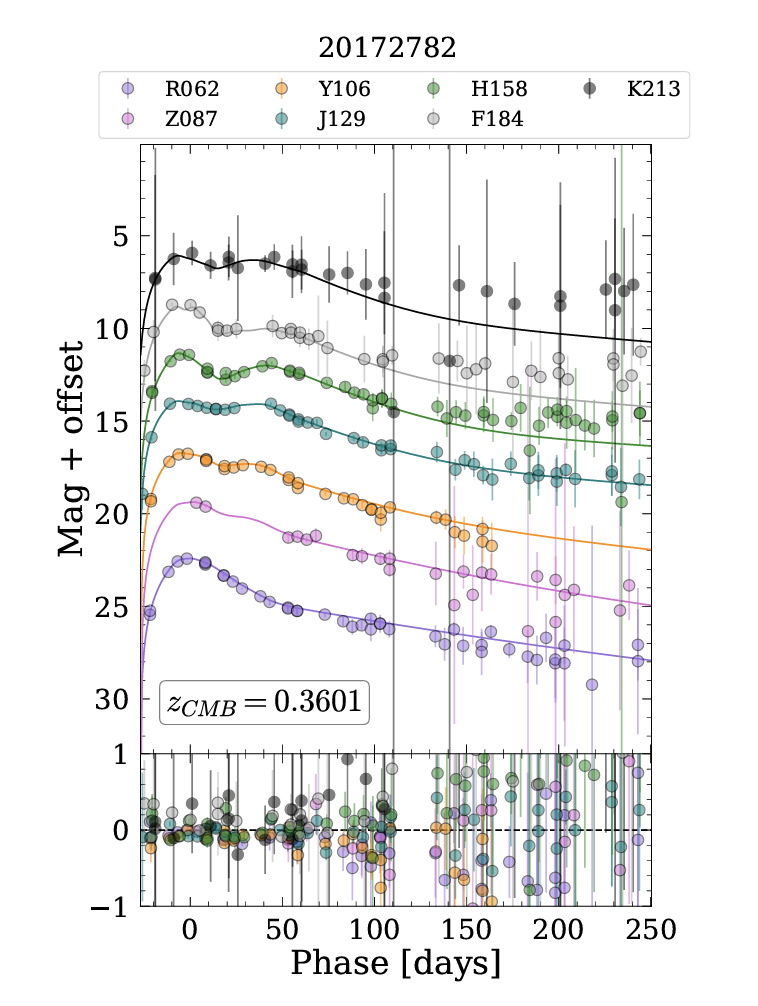
We present a simulation of the time-domain catalog for the Nancy Grace Roman Space Telescope’s High-Latitude Time-Domain Core Community Survey. This simulation, called the Hourglass simulation, uses the most up-to-date spectral energy distribution models and rate measurements for ten extra-galactic time-domain sources. We simulate these models through the current baseline Roman survey: four filters per tier, a five day cadence, over two years, a wide tier of 19 deg2 and a deep tier of 4.2 deg2 , with ∼20% of those areas also covered with prism observations. We find that a general time-domain catalog, assuming a S/N at max of >5, would have approximately 25,000 Type Ia supernovae, 70,000 core-collapse supernovae, over 70 superluminous supernovae, ∼40 tidal disruption events, 5 kilonovae, and possibly the first confirmed detection of pair-instability supernovae. Hourglass is a useful data set to train machine learning classification algorithms. Additionally, we present the first realistic simulations of non-Type Ia supernovae spectral-time series data from Roman’s prism.
This research has been published in ApJ: 2025ApJ...988...65R

Fishing for the Optimal Roman High Latitude Time Domain Survey: Cosmological Evaluation of Thousands of Proposed Surveys
Lead Authors: David Rubin
The upcoming Nancy Grace Roman Space Telescope is set to conduct a generation-defining SN cosmology measurement with its High Latitude Time Domain Survey (HLTDS). However, between optical elements, exposure times, cadences, and survey areas, there are many survey parameters to consider. This work is part of a Roman Project Infrastructure Team effort to help the Core Community Survey (CCS) Committee finalize the HLTDS recommendation. We simulate 1,000 surveys, with and without a conservative version of the Vera C. Rubin Observatory Deep Drilling Field SNe, and compute Fisher-matrix-analysis Figure of Merits (FoM) for each. We investigate which survey parameters correlate with FoM, the dependence of the FoM values on calibration uncertainties and the SN scatter model, and show simulated light curves for the CCS recommendation. We release distance-modulus covariance matrices for all surveys to the community.
This research was submitted to ApJ: 2025arXiv250604327R
